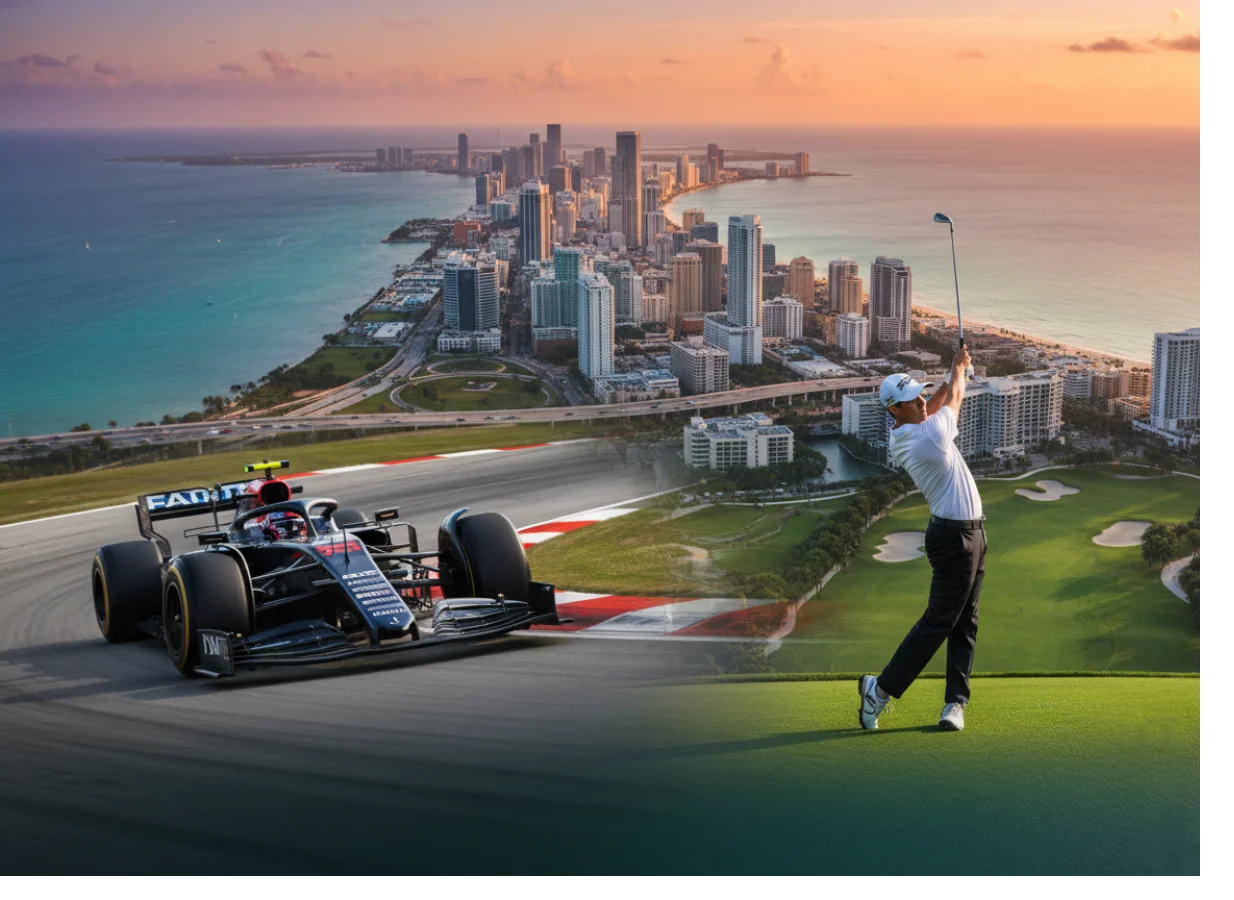
South Florida is not just a beach-and-warm-weather destination. It’s a full sports ecosystem: professional leagues, global mega-events, elite equestrian circuits, motorsports, top-tier tennis tournaments, massive marathons, and a water culture that turns the ocean into a stadium. If you travel the West Palm Beach → Boca Raton → Fort Lauderdale → Miami → Homestead corridor, you’ll notice one common trait: there’s almost always a major event underway—and when there isn’t, people are training for the next one.
This post is a broad (and practical) guide to understanding which sports dominate the region, where they’re experienced, what their main championships are, and why South Florida has become one of the most powerful sports regions in the United States.
1) The “sports geography” of South Florida
When we talk about “South Florida,” we’re usually referring to three counties that function as a single sports scene:
- Palm Beach County (West Palm Beach, Boca Raton, Wellington, Jupiter)
- Broward County (Fort Lauderdale, Hollywood, Sunrise)
- Miami-Dade County (Miami, Miami Beach, Miami Gardens, Homestead)
That geographic continuity enables something very specific: you can attend a pro game at night, drive 45–60 minutes, and the next day be at an international equestrian event in Wellington, at the Homestead speedway, or at a top-tier tennis tournament in Miami Gardens. It’s a region built to consume sports as an experience—not just as a final score.
2) The professional block: teams that define local identity
American football (NFL): Miami Dolphins
The NFL is the great Sunday ritual for millions of people in the U.S., and in South Florida it revolves around the Miami Dolphins, based at Hard Rock Stadium (Miami Gardens). Hard Rock Stadium positions itself as the Dolphins’ “home” and as a multi-event venue (including F1 Miami and the Miami Open).
Beyond the sport itself, the Dolphins are part of the local cultural language: tailgates, vintage jerseys, bars that fill up early, and a season calendar that sets the social agenda.
Basketball (NBA): Miami Heat
In Miami, the Heat is both brand and symbol. They play at the Kaseya Center (Downtown Miami). The venue publishes the team’s game schedule, confirming its role as the primary home for regular-season matchups.
Baseball (MLB): Miami Marlins
The Miami Marlins play at loanDepot park, and the team’s official MLB site emphasizes the stadium as their home base and gathering point for games and events.
Hockey (NHL): Florida Panthers
Even though the team is “Florida” rather than “Miami,” the Florida Panthers are central to South Florida’s sports map. They play at Amerant Bank Arena in Sunrise, and the NHL highlights this explicitly.
Soccer / fútbol (MLS): Inter Miami CF and the Messi effect
Soccer in the U.S. saw a historic leap in attention with Lionel Messi’s arrival in the MLS. In South Florida, that phenomenon has a proper name: Inter Miami CF. The club currently plays at Chase Stadium (Fort Lauderdale) and, in its official communications, already projects its future home (Miami Freedom Park) for 2026.
If you want the simplest way to locate it: “the soccer where Messi plays” in the region is Inter Miami, and its current stadium sits right on the Miami–Fort Lauderdale axis—perfect for the corridor we’re describing.
3) Mega-events that internationalize the region
Formula 1: Miami Grand Prix
The Miami Grand Prix cemented Miami as a global capital of modern motorsport. It’s raced at the Miami International Autodrome, a circuit built around Hard Rock Stadium. Official event information highlights key track data: 5.41 km, 19 turns, and DRS zones, with very high speeds.
Why does this matter? Because F1 isn’t just a race—it’s high-spend tourism, premium hospitality, concerts, luxury brands, and global exposure. F1 weekend reshapes the local economy: hotels, restaurants, transport, private events, and a full week of activations.
Tennis: Miami Open
The Miami Open is one of the most important tournaments in the world outside the Grand Slams: it brings together the ATP and WTA elite and is played at Hard Rock Stadium. The tournament’s site confirms the venue and address, and the WTA classifies it as WTA 1000, on outdoor hard courts.
From a city perspective, the Miami Open is the “bridge event” connecting sports and lifestyle: fashion, hospitality, sponsorships, and an international community that travels specifically for the tournament.
Boating: Miami International Boat Show and Fort Lauderdale International Boat Show (FLIBS)
If there’s one sports-economic trait that distinguishes South Florida, it’s the ocean.
• Discover Boating Miami International Boat Show: promoted as Miami’s flagship boating event, and its official guide describes a multi-venue format: Miami Beach Convention Center, Pride Park, Herald Plaza, Venetian Marina, and Museum Park, plus access tied to superyacht showcases.
• Fort Lauderdale International Boat Show (FLIBS): recognized as the major in-water show. The official site lists multiple locations (including Broward County Convention Center, Bahia Mar, Las Olas Marina, among others) and confirms dates Oct 29 – Nov 2, 2025.
These events aren’t “exhibitions” only: they’re business platforms for manufacturers, brokers, marinas, shipyards, maintenance services, and the entire luxury boating ecosystem.
4) Motorsport and speed: NASCAR in Homestead
If F1 is global glamour, NASCAR is American tradition. And in South Florida, the temple is Homestead-Miami Speedway.
The speedway itself announces the return of NASCAR weekend (March 21–23, 2025) and confirms the Cup Series races there on those dates. NASCAR also publishes the official Homestead-Miami weekend schedule, reinforcing that it’s a real stop on the motorsport calendar.
In terms of experience, Homestead offers something different from F1: more family-oriented, more traditionally American, with track culture, grilling, music, and a fan community that travels by road to follow the season.
5) Endurance sports: running seriously in Miami
Marathon and half marathon
High-volume running is massive in South Florida, and the flagship event is the Life Time Miami Marathon & Half. The organization publishes logistics and street-closure information by zone (Downtown/Brickell, Miami Beach, Venetian Causeway, Rickenbacker, Coconut Grove), reflecting the event’s real urban footprint.
In addition, local official portals describe it as the city’s largest endurance gathering, with international participation and tens of thousands of runners.
Triathlon, cycling, and outdoor training
While heat and humidity demand strategy (hydration, timing, recovery), South Florida’s advantage is that there’s practically no “off-season.” It’s a region where training becomes part of daily life: coastal routes, bridges for interval work, parks for mobility and strength, and clubs active year-round.
6) Golf: the ultimate corporate sport (with Palm Beach as the epicenter)
Golf has structural presence here: sheer course volume, club culture, an international community, and tournaments. Palm Beach County—especially the Palm Beach Gardens / Jupiter / Boca Raton axis—is natural territory for competitive and social golf.
In South Florida, golf operates at three levels:
- Social sport and networking (private clubs, memberships, internal tournaments)
- Amateur and collegiate competition (leagues, teams, tournaments)
- Professional circuit (PGA and satellite events)
For many audiences, golf isn’t just sport—it’s a language of relationships, business, and lifestyle.
Check this post about Best 12 Golf Courses in South Florida
7) Tennis beyond the Miami Open: academies, clubs, and competitive culture
Tennis in South Florida doesn’t stop at one annual tournament. The region is supported by:
- High-performance academies
- Private and public clubs
- Junior and collegiate tournaments
- An international resident community (Latam, Europe, Canada) that sustains constant demand
The Miami Open is the media peak, but the real engine is the training-and-club ecosystem that keeps tennis alive year-round.
8) Beach volleyball, sand sports, and the natural court
The beach in South Florida isn’t decorative—it’s sports infrastructure. Beach volleyball, with its two-on-two dynamic and outdoor culture, fits perfectly in Miami Beach, Fort Lauderdale, and parts of Palm Beach.
Competitively, it’s fueled by local tournaments, regional circuits, and high-level events when the calendar brings them. But above all, it’s practiced as a habit: functional training, coordination, community, and social life.
9) The equestrian world: Wellington and the elite international circuit
Few people outside sports truly understand Wellington’s weight (Palm Beach County) in the global equestrian circuit. The Winter Equestrian Festival (WEF) runs from January to March, with 13 weeks of FEI-sanctioned international competition, and is complemented by the Global Dressage Festival.
Wellington is a sports economy in itself: horses, barns, specialized veterinary care, logistics, high-net-worth tourism, and an international community that “lives the season” like a complete social calendar.
10) Water sports: the ocean as a playing field
Here, the ocean isn’t scenery—it’s the center. South Florida is defined by its relationship with water, and that translates into sports:
- Sailing: yacht clubs, regattas, technical training
- Sport fishing: offshore tournaments, deep-sea fishing, specialized community
- Scuba and freediving: reefs, shipwrecks, technical training
- Paddleboard and kayak: bays, canals, mangroves, and urban routes
- Rowing: clubs and training, especially in protected areas
And on the top layer are races and shows: the E1 Series (electric powerboats) has already positioned Miami as part of its global circuit since 2025, reinforcing the trend toward electric mobility on the water as well.
11) Jai Alai: the “unique” sport you only understand when you see it
Few sports capture the blend of tradition and spectacle like Jai Alai, which has a historical connection to Florida. It’s fast, technical, played in a large fronton, with a ball traveling at very high speeds. Most interestingly, it remains a deeply local experience—with an audience that understands it and defends it.
In South Florida, Jai Alai plays a cultural role: it’s not the most massive sport, but it’s one of the most identity-defining.
12) The calendar as an asset: why South Florida wins
When a region sustains pro sports + mega-events + training ecosystems + outdoor culture + the ocean as infrastructure, what it gains isn’t just entertainment—it gains an economic and cultural asset.
- It attracts high-spend tourism (F1, boat shows, tennis)
- It sustains hotel occupancy across multiple “seasons”
- It generates direct and indirect jobs (venues, security, hospitality, production)
- It increases international exposure for the “Miami” brand and the coastal corridor
And for anyone who lives here or visits often, the conclusion is simple: sport in South Florida isn’t an isolated event. It’s a system.
If you want to understand the real energy of South Florida, look at its sports. In a single geographic corridor you can go from NHL and NBA, to a Masters 1000 tennis event, to a NASCAR weekend in Homestead, to an international equestrian circuit in Wellington—and end at a boating show that concentrates the global yachting market.