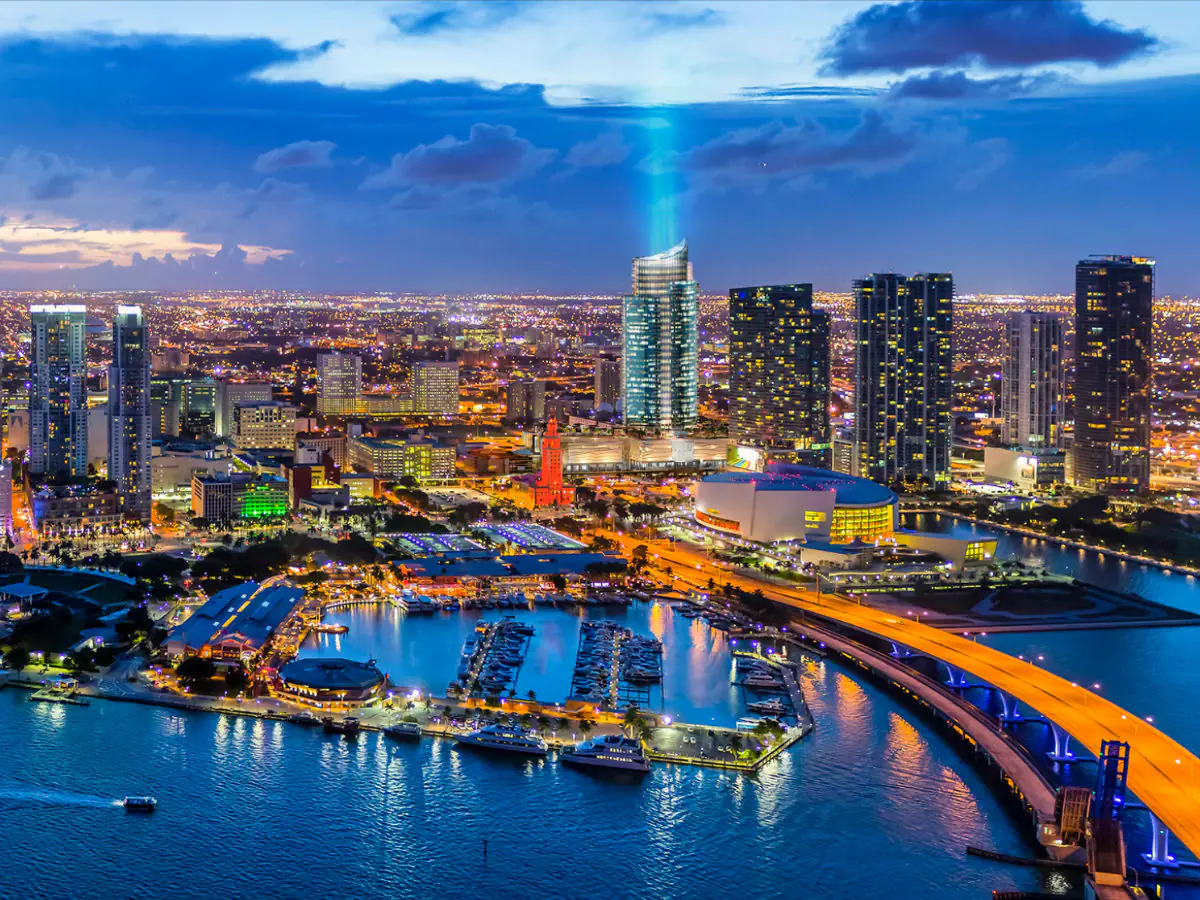
Downtown is where Miami stops pretending it’s just a beach city.
If Brickell is the polished engine room, Downtown is the narrative—Miami telling the world what it wants to become. You don’t move here because you want “close enough.” You move here because you want to feel the city. You want the skyline outside your window to mean something. You want to step outside and sense momentum.
Downtown has always been about access: to business, to waterfront, to culture, to transit. What’s changed—especially around Miami Worldcenter and Park West—is the density of reasons to stay. The neighborhood is evolving into a more complete urban environment, where living, dining, events, and daily convenience are not separate trips, but one connected ecosystem. That matters for families who want an active life without needing a car for every chapter of the day.
In Downtown, mornings can be surprisingly calm if your building is well-positioned. The early hours belong to residents: coffee in the lobby, a walk near the bay, a quick workout, and then the city fills in behind you. Afternoons bring the rhythm of work and movement. Evenings bring the payoff: performances, restaurants, spontaneous plans that don’t require a long drive or a major decision. For the right profile, Downtown feels like freedom—life becomes more immediate.
Miami Worldcenter, in particular, represents a modern “district” concept: a place that’s designed to be walked, experienced, and repeated. Park West adds another layer, bridging entertainment, residential growth, and proximity to key Downtown anchors. For buyers relocating from New York, Chicago, London, or Latin American capitals, this is the part of Miami that feels familiar: a real downtown with lights on at night, not just a daytime business zone.
Here’s the honest part: Downtown is not for people who need the city to behave quietly.
Downtown comes with noise pockets, event surges, and the reality of a neighborhood that is still actively developing in sections. On some nights, the energy is exactly what you wanted. On others, it’s the reason you close the balcony doors. This is why micro-location matters more here than almost anywhere else. One side of a building can feel peaceful; the other can feel exposed to the city’s most unpredictable moments.
Downtown also demands building diligence. In high-rise living, your experience depends on operations: management, security, reserves, elevator capacity, rules for residents and guests, and how the building handles the real-world stress of urban life. People often fall in love with views and forget governance. In Downtown, governance is the difference between “this is effortless” and “this is a headache.”
From a lifestyle perspective, Downtown fits families who want cultural proximity and a walkable life, and who are comfortable with the urban trade-offs. If your family thrives on options—museums, performances, sports, dining, last-minute plans—Downtown can feel like the most “complete” version of Miami. If your family’s ideal weekend is quiet routines and early bedtimes, you may prefer a different rhythm.
The strongest Downtown strategy for many sophisticated buyers is clarity: define the purpose of the property. Is this your primary home? A seasonal base? A relocation bridge while you decide between Miami and Palm Beach? A place that supports work and travel? Downtown can be exceptional for all of those—but only when the building and the corridor match the purpose.
Downtown is not a postcard neighborhood. It’s a city neighborhood. It rewards people who like reality, movement, and proximity. If that’s you, you’ll love it. If it isn’t, it will remind you daily.